Search is no longer limited to typing a question into Google and choosing from a list of blue links. Customers can now ask Google’s AI features, ChatGPT, Gemini, Claude, and other AI-powered platforms to find businesses, compare options, research products, and answer questions.
That change has left many business owners asking a straightforward question: is SEO dead?
If AI can provide an answer immediately, do you still need a website? If customers can discover businesses through AI, is it still worth investing in search engine optimization? And with Google increasingly placing AI-generated answers alongside traditional results, does traditional SEO still have a place in 2026?
The short answer is that the role of search is changing, but that does not mean businesses no longer need to be discoverable online.
What has changed is the path a customer can take to find your business.
A potential customer might find you through a traditional Google search, an AI Overview, an AI assistant, a recommendation, a review, or another website before eventually deciding whether to engage with your business.
That is why the question “is SEO dead in 2026?” needs a more useful business-oriented answer than simply yes or no.
The real question is:
When customers can discover businesses through both search engines and AI, do you still need a website, SEO, and a credible online presence?
To answer that, we need to look at what has actually changed, and what still matters when a customer is trying to find, understand, evaluate, and ultimately choose a business.
Do Businesses Still Need a Website When Customers Can Ask AI Instead?
AI has made it easier for customers to discover businesses without starting with a traditional search engine. Someone can ask ChatGPT, Gemini, or another AI tool to recommend a software company, find a local service provider, compare products, or suggest businesses in a particular industry.
But being introduced to a business is different from having enough information to make a decision.
A customer may see your business mentioned in an AI-generated answer and immediately have follow-up questions: What exactly do you offer? How much does it cost? Do you serve their location? What experience do you have? Can they see examples of your work? How can they contact you?
Your website is where those questions can be answered in one controlled, complete place.
Your Website Is Still Your Owned Source of Business Information
A business website gives you control over how your company, products, and services are presented.
For example, imagine a customer asks an AI tool to find a company that provides commercial roofing services. The AI may mention your business because it has information about your company from different online sources. The customer may then visit your website to check which roofing systems you install, which areas you serve, what types of projects you handle, and how to request an estimate.
Without a website, that customer may have to piece together information from directories, social media profiles, review platforms, or other third-party sources. Some of those sources may contain useful information, but they may not provide the complete or most current picture of your business.
A website also allows you to publish information that third-party platforms cannot fully represent, such as detailed service pages, product specifications, case studies, FAQs, policies, industry expertise, and customer resources.
Can Customers Trust AI’s Answer Without Visiting Your Website?
Not every customer will need to visit a website after receiving an AI-generated answer. For simple questions, the answer itself may be enough.
However, business decisions often require more context. Consider someone looking for accounting software for a growing company. An AI tool might recommend a particular platform, but before signing up, the customer may want to check its features, integrations, pricing plans, security information, customer support options, and implementation process.
That deeper information needs to exist somewhere.
The website provides the original business context behind the short introduction a customer may receive through AI. It gives the customer an opportunity to verify the information rather than relying entirely on a summarized description.
Does Having a Website Mean Customers Will Automatically Find You?
No. A website gives a business an owned digital destination, but it does not guarantee visibility.
Customers still need ways to discover that website in the first place. They may find a business through search engines, AI-powered search, maps, reviews, social platforms, industry publications, referrals, or other online sources.
This creates an important distinction: your website is the destination, while search and other digital channels help customers discover it. A website gives customers a place to verify your business, explore your offerings, and take the next step, but it does not guarantee that they will find you.
As AI becomes another way for people to discover businesses, the bigger question is how businesses remain visible across these changing discovery paths. That is where SEO still has a role to play.
If Customers Are Using AI Alongside Google, Does SEO Still Matter?
Search remains an important part of how customers research products, services, and businesses, even as AI introduces new ways to find information.
Instead of treating AI and search as competing channels, it is more useful to view them as overlapping parts of a broader discovery journey. A customer might begin with Google, ask an AI assistant for recommendations, compare businesses through reviews, or move between several of these sources before reaching a company’s website.
For businesses, this means SEO still matters—but its role can no longer be understood only through traditional search rankings.
Does Traditional Google Search Still Matter?
Traditional search has not simply disappeared because AI-powered search experiences are becoming more common.
A customer may still search Google for something as specific as:
- “best CRM for a small real estate company”
- “commercial plumber near me”
- “accounting firms for startups”
- “how much does commercial roofing cost?”
They may also use search after discovering a business elsewhere. For example, someone might hear about a company from an AI recommendation and then Google the company name to find its website, reviews, location, or other information.
This means search can play different roles in the customer journey. It can introduce a business, help a customer research it, or help them verify information they have already encountered elsewhere.
Google is also incorporating AI directly into its search experience rather than treating AI and search as completely separate systems. Its AI Overviews and AI Mode can provide synthesized answers while continuing to connect users with web sources and links.
Google and AI should therefore not be viewed as an either-or choice. Customers can move between traditional search, AI-generated answers, reviews, maps, and business websites depending on what they need at different stages of their research.
The result is a broader discovery environment in which traditional search remains one important channel, but no longer represents the entire search experience.
Is SEO Still About Ranking in Google’s Blue Links?
Ranking in traditional organic results remains an important part of SEO, but rankings are only one way a potential customer can encounter a business.
A business can appear in a traditional result, a local result, an AI-generated response, a review platform, a product listing, or a third-party publication. Each of these can contribute to how a customer discovers and evaluates the business.
Previously, a business might measure its SEO success primarily through questions such as:
“What position does my website have for this keyword?”
That question still has value, but it does not capture every way customers can now encounter information about a business.
A customer might discover your company through a traditional search result, an AI-generated answer, a local result, a review, a product listing, or a third-party publication.
The broader question is therefore:
Can the right information about my business be discovered when a potential customer is looking for what I offer?
That is where the role of SEO starts to expand.
What Has Actually Changed About SEO?
The fundamentals of being discoverable have not disappeared, but the environment in which discovery happens is becoming more complex.
A useful example is a local HVAC company.
A few years ago, the company’s primary search goal might have been to rank for terms such as “HVAC repair in Phoenix.” Today, a customer could ask an AI tool something much more conversational:
“I need an HVAC company in Phoenix for an older home. Which companies have experience with older systems and offer emergency repairs?”
The customer’s search is no longer just a keyword. It contains context, intent, and specific requirements.
For the business, that means simply targeting a short keyword is not enough. Its online information needs to clearly explain what it does, where it operates, which customers it serves, and what makes its services relevant.
The important shift is not that traditional SEO has suddenly become irrelevant. It is that search visibility now depends on more than matching a webpage to a keyword.
Businesses increasingly need to make their information clear, relevant, specific, and useful enough to match the different ways customers express their needs. The next question is what happens when the search engine itself starts generating the answer instead of simply presenting a list of results.
Does Google AI Overview Make SEO Less Important or More Important?
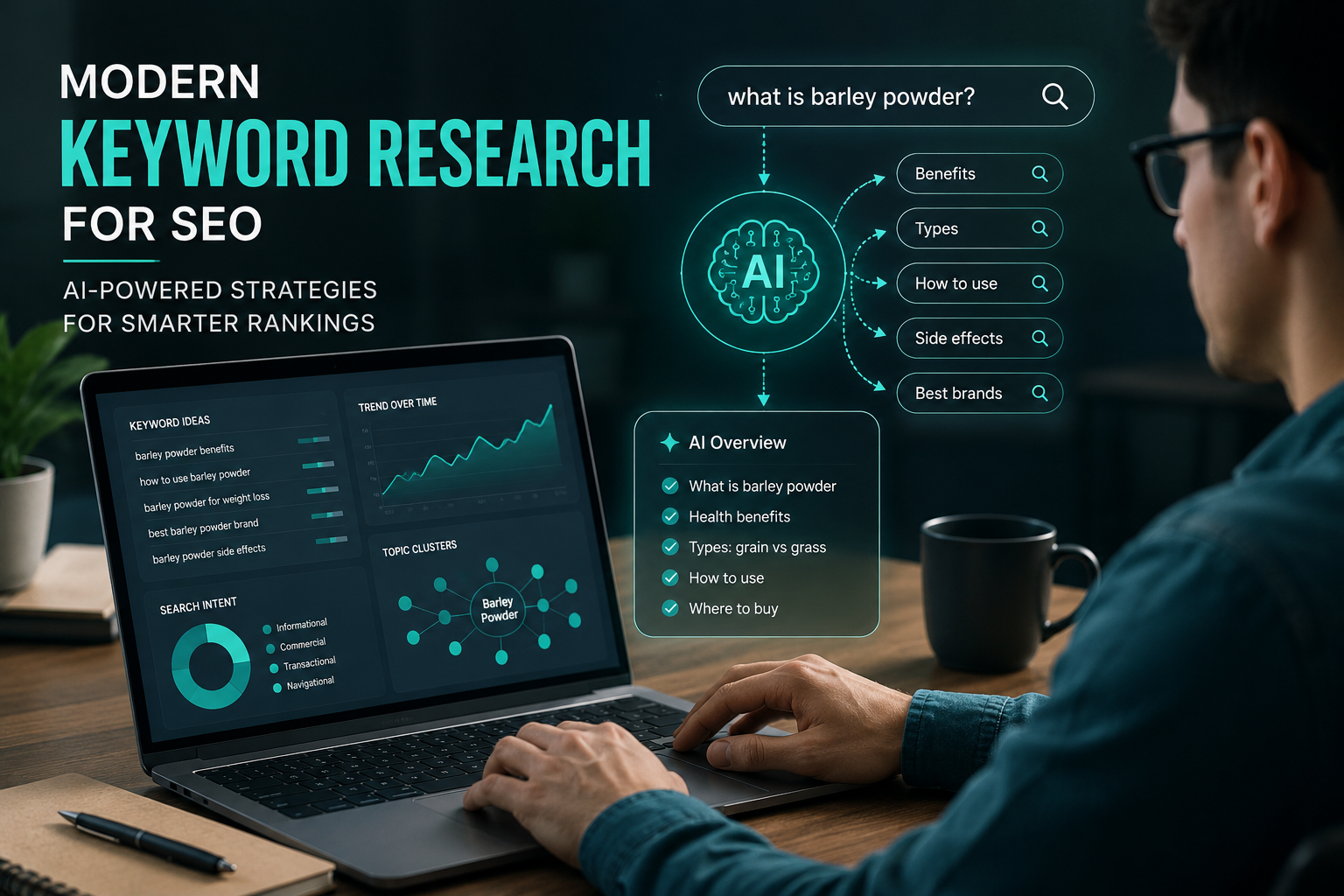
Google Search is no longer limited to showing a list of webpages for every query. With AI Overviews and AI Mode, Google can now use AI to organize information from multiple sources and present a conversational response directly within the search experience. Google has continued expanding these AI-powered experiences while retaining links that allow users to explore supporting webpages and other sources.
For businesses, this creates a different search environment. A customer may no longer begin their journey by choosing one of ten blue links. Instead, they may first receive an AI-generated explanation, compare information from several sources, and then decide which websites are worth visiting.
That raises an important question: if Google can answer the question directly, what role does a business website and its search visibility play?
The answer starts with understanding where the information in those AI responses comes from.
Where Does Google Get Information Behind AI Search Results?
AI-generated search responses need information to work with. Google’s AI Search experiences can synthesize information from across the web and provide links to relevant sources so users can investigate the information further.
For a business, this means its online information can serve two purposes.
First, it can help customers understand the business directly.
Second, it can provide information that search systems can use when responding to questions related to the company’s products, services, expertise, or industry.
For example, imagine a company that sells commercial solar systems.
Its website might contain:
- Product specifications
- Installation information
- Service areas
- Commercial project examples
- Maintenance information
- Financing details
- Frequently asked questions
- Industry guides
- Information about different solar technologies
Now consider a customer searching:
“What should a manufacturing company consider before installing commercial solar panels?”
The customer may receive an AI-generated response discussing system size, energy consumption, installation requirements, costs, maintenance, and other considerations.
The customer may then explore some of the sources behind that information.
The business does not need to create a page specifically titled “How to appear in AI Overviews.” Instead, it needs to make its actual expertise and business information available in a clear and useful format.
Can Your Business Appear in an AI Overview Without Being Discoverable on the Web?
AI systems cannot reliably understand what a business offers if there is little accessible information about that business online.
However, this does not mean that simply having a website guarantees an appearance in an AI Overview.
Search visibility is determined by the search system, the query, relevance, available information, and other factors.
For business owners, it is more useful to think about the information foundation they control.
A business should make important information clearly available, including:
- Business identity: Who are you?
- Products or services: What exactly do you provide?
- Audience: Who are your products or services designed for?
- Location: Where do you operate?
- Expertise: What areas do you have experience in?
- Use cases: What problems do your products or services solve?
- Evidence: What demonstrates your experience or expertise?
- Customer information: What questions do customers commonly ask?
- Contact information: How can a potential customer reach you?
The clearer this information is, the easier it is for a customer to understand the business when they encounter it through search.
What Happens to Blue Links When AI Gives the Answer First?
Traditional organic results have not simply disappeared. Instead, they can become one part of a broader search experience.
A traditional search journey might look like:
Search query → Organic results → Website → Research
An AI-assisted journey can look more like:
Search query → AI-generated response → Sources → Website → Further research
The difference is that the customer may receive context before choosing a website.
For example, suppose someone searches:
“What are the best options for managing payroll for a company with 100 employees?”
Instead of immediately opening several payroll software websites, the customer may first receive an AI-generated overview of different approaches, features to consider, and potential providers.
The customer can then decide which companies deserve closer attention.
This means the business may be encountered at an earlier stage of the customer’s research process.
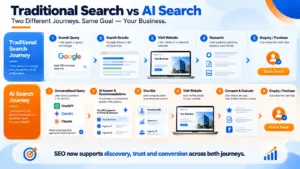
How Traditional Search and AI Search Can Differ
| Traditional Search Experience |
AI-Powered Search Experience |
| Customer enters keywords |
Customer can ask a detailed question |
| Search results display individual pages |
AI can summarize information from multiple sources |
| Customer chooses which result to open |
Customer may receive context before choosing a source |
| Research happens mainly by opening webpages |
Some initial research happens within the search interface |
| Rankings are highly visible |
The customer’s first interaction may be an AI-generated response |
| Website visits can begin immediately |
Website visits may happen after the customer receives an initial answer |
This does not mean one format completely replaces the other.
A customer can move between them depending on the complexity of the question and what they need to accomplish.
Can AI Overviews Reduce Website Clicks?
The effect can differ from one search to another.
If someone searches a simple factual question, an AI-generated response may provide enough information that they do not need to open a website.
For example:
“What is the difference between a fixed-rate and variable-rate mortgage?”
The customer may only need a short explanation.
But consider a more commercially important search:
“Which mortgage provider offers options for self-employed borrowers, and what documents will I need?”
Now the customer may want detailed information, eligibility requirements, rates, terms, application instructions, and other specifics.
Similarly, someone searching for:
“Which commercial roofing company should I contact for a warehouse roof replacement?”
may want to investigate individual companies after receiving an initial answer.
Google has continued to emphasize links and ways for users to explore sources within its AI Search experiences, rather than presenting AI answers as the only destination.
So the effect on website visits depends heavily on search intent.
| Search Intent |
Likely Customer Need |
| Simple factual question |
A quick answer may be enough |
| Educational research |
More detailed sources may be useful |
| Product comparison |
Customers may investigate several businesses |
| Local service search |
Customers may check location, reviews, services, and contact details |
| High-value purchase |
Customers often need detailed verification before acting |
| Transactional search |
Customers may eventually need a website to purchase, book, or enquire |
The key distinction is between answering a question and making a business decision.
AI can increasingly help with the first. The second may still require customers to investigate specific businesses and their offerings.
What Does This Mean for Businesses?
The arrival of AI Overviews changes the environment in which businesses compete for attention.
Instead of thinking only about:
“How do I get my webpage to rank?”
businesses also need to consider:
- Is the information about my business clear?
- Are my important products and services explained properly?
- Can customers understand what makes my offering relevant?
- Is the information accurate and current?
- Are important business details easy to verify?
- Does my website provide enough information for someone who discovers me through an AI-generated answer?
- Are there credible sources beyond my own website that provide context about my business?
This does not create a separate replacement for SEO.
Instead, it expands the context in which search visibility matters.
The Bigger Change: From Result Selection to Information Discovery
The most important change brought by AI Search is that customers can receive an explanation before they select a website.
That changes the first stage of discovery.
A customer might not initially ask:
“Which website should I visit?”
They might ask:
“What are my options?”
or:
“What should I look for?”
or:
“Which type of company can solve this problem?”
AI can help answer those broader questions and introduce businesses within that research process.
Once a customer becomes interested in a particular company, however, the journey can move beyond the search interface into deeper research.
That is why AI Overviews should not be viewed simply as a replacement for traditional search results. They represent another layer between the customer’s question and the information they eventually choose to investigate.
And that brings us to the next question: when AI has to understand a business well enough to mention it, what information actually helps it understand that business?
How Do AI Systems Know About Your Business?
When an AI system needs to answer a question about a business, it needs enough information to understand what that business does, who it serves, where it operates, and how it relates to the customer’s request.
That information can come from the business website as well as other online sources. This makes clarity and consistency important. If a company’s website describes it one way while other prominent sources provide outdated or conflicting information, customers—and the systems interpreting that information—may have a less complete picture of the business.
Consider these two descriptions:
Company A:
“We provide technology solutions for modern businesses.”
Company B:
“We provide cloud-based inventory management software for independent retailers, including stock tracking, purchase orders, barcode management, and multi-location reporting.”
The second description gives considerably more context. It identifies the product, target audience, use cases, and key capabilities. A customer can immediately understand whether the company is relevant to a particular need.
The same principle applies to the wider online presence of a business. Important details should be specific enough for customers to understand and consistent enough across major sources to avoid unnecessary confusion.
Does AI Know Your Business Simply Because You Have a Website?
No.
Having a website gives a business a place to publish information, but simply owning a domain does not explain everything about the company.
For example, a customer searching for:
“Which companies provide emergency commercial plumbing services in Houston?”
needs more than a company name and a generic statement such as “full-service plumbing.”
The business should clearly communicate relevant details such as:
- Commercial plumbing services
- Emergency repair availability
- Service areas
- Types of commercial properties served
- Specific services offered
- How customers can request emergency assistance
This gives both customers and search systems more context for determining whether the business matches a particular need.
What Information Should Your Business Make Clear?
There is no single formula that guarantees an AI system will mention a business. Different search and AI platforms can access, weigh, and interpret information differently.
For business owners, the practical priority is simpler: make the information customers need clear, current, specific, and easy to verify.
| Business Information |
What Customers Need to Understand |
| Business name |
Who are you? |
| Products or services |
What do you provide? |
| Target customers |
Who is it designed for? |
| Locations/service areas |
Where do you operate? |
| Expertise |
What do you specialize in? |
| Use cases |
What problems do you solve? |
| Key features |
What does your product or service include? |
| Contact details |
How can customers reach you? |
| Policies and practical details |
What should customers know before taking action? |
The goal is not to create information simply because “AI needs content.” The goal is to make the business easier for real customers to understand, evaluate, and contact.
Can Inconsistent Information Make a Business Harder to Understand?
Potentially, yes.
Imagine a company that has moved from Chicago to Dallas but still has its old Chicago address listed on several websites. Its own website may also describe services that are no longer offered, while another business profile uses an outdated company name.
For a customer, these inconsistencies can create uncertainty about basic facts. Before investing in more content, a business should make sure the information it already has online is accurate and current.
Important details to check include:
- Business name
- Website URL
- Address
- Phone number
- Service areas
- Opening hours
- Products and services
- Business categories
- Current contact information
This is particularly important for businesses that depend on local discovery, where location, opening hours, service areas, and contact details can directly affect whether a customer can act on the information they find.
A Practical Business Information Audit
Business owners can perform a basic audit to identify outdated or conflicting information before focusing on more advanced search visibility work.
| Check |
What to Look For |
Action |
| Business identity |
Same company name and branding |
Correct outdated variations |
| Services |
Current services clearly listed |
Remove discontinued services |
| Products |
Accurate product information and specifications |
Update outdated details |
| Locations |
Correct offices and service areas |
Remove old locations |
| Contact details |
Working phone, email, and contact forms |
Test and update them |
| Hours |
Current opening/operating hours |
Update seasonal changes |
| Website pages |
Important services have useful information |
Improve unclear or thin pages |
| FAQs |
Common customer questions are answered |
Add genuinely useful questions |
| Business profiles |
Major profiles contain current information |
Correct inconsistencies |
| Old content |
Outdated claims or offers remain online |
Update, remove, or replace them |
A simple way to conduct the audit is to search for the business as a customer would—for example, “ABC Roofing Dallas.” Then compare the information shown across the company’s website, business profiles, directories, social platforms, and other prominent sources.
If basic facts do not match, correct those inconsistencies before creating more content.
Does More Content Automatically Make a Business Easier to Understand?
No.
A business does not need hundreds of pages simply to appear more informative. Consider a dental clinic. Fifty articles repeating general oral-health advice may add little value if the website still does not clearly explain its treatments, location, appointment process, areas of expertise, and patient information.
A smaller set of well-organized pages can provide stronger context when it answers the questions customers actually have.
The priority should be:
Clear information → Useful information → Current information
rather than:
More pages → More words → Better visibility
Does Your Business Need More Than SEO to Be Discoverable?
Having accurate information on your website gives customers a clear understanding of what your business offers. But a business is rarely evaluated through its own website alone.
Customers also look at reviews, industry publications, professional profiles, directories, social platforms, recommendations, and other independent sources. These sources can provide additional context about a company’s experience, reputation, and presence within its industry.
This is where business authority becomes important.
Authority is not simply a technical SEO score. It is the broader body of information and evidence that helps establish that a business is legitimate, relevant, experienced, and recognized for what it claims to do.
What Does Business Authority Mean in the AI Era?
Think of authority as the difference between a business making a claim and a business having information around the web that supports that claim.
For example, a marketing agency might say on its website:
“We specialize in B2B SaaS marketing.”
That tells customers what the agency claims to specialize in.
Now imagine that the same agency also has:
- Case studies showing SaaS campaigns
- Industry articles discussing its expertise
- Client reviews describing relevant projects
- Conference appearances
- Professional profiles
- Interviews or expert contributions
- Consistent information across reputable business platforms
These sources provide additional context.
None of them guarantees that an AI system will recommend the company. However, together they can create a more complete picture of the business than its website alone.
Is Domain Authority the Same as Business Authority?
No.
The terms may sound similar, but they refer to different concepts.
Domain authority is commonly used in the SEO industry to describe the strength or authority of a website or domain, often through third-party metrics.
Business authority is broader.
It relates to how well a company is established, represented, and supported by relevant information across its online presence and industry.
For example, a newly launched website could have a technically optimized structure but very little independent information about the company.
Another business may have operated for years, have extensive customer feedback, industry recognition, published expertise, and numerous relevant references.
Looking only at the website misses part of the picture.
For business owners, the more useful question is:
“What evidence supports our position in the market?”
Do Reviews, Publications, and Third-Party Mentions Matter?
They can provide context that a business cannot create entirely by talking about itself.
Consider a local home-remodeling company.
Its website can explain that it provides kitchen renovations, bathroom remodeling, and whole-home projects. But customers may also want to know:
- Have other customers worked with this company?
- What was their experience?
- Has the company worked on projects similar to mine?
- Has it been mentioned by relevant organizations or publications?
- Does it have experience in this particular type of project?
Reviews, case studies, industry mentions, and other relevant references can help answer those questions.
The important word is relevant.
A large number of unrelated mentions does not automatically establish meaningful authority. A small number of credible references closely connected to the company’s industry can be more useful than a collection of unrelated pages.
Why Do Reviews Matter?
Reviews provide a perspective that the business itself does not control completely.
A company can describe its service as reliable, responsive, or high quality. Customer reviews can provide independent experiences of those claims.
For example, a moving company might say:
“We provide reliable interstate moving services.”
Customer reviews may discuss whether the company communicated well, handled belongings carefully, arrived on time, or resolved problems effectively.
Reviews therefore serve a different purpose from website content.
Website content explains what the business offers. Reviews provide customer perspectives on the experience.
Why Do Industry Publications and Mentions Matter?
Third-party coverage can provide additional evidence of a company’s involvement in its industry.
For example, a cybersecurity company might publish extensive material about ransomware protection on its own website. If security publications, industry organizations, conferences, or relevant business media also discuss the company’s expertise, customers gain another layer of context.
This does not mean businesses should try to collect mentions simply for the sake of increasing their numbers.
The focus should be on genuine industry relevance.
Useful third-party visibility can come from:
- Industry publications
- Professional organizations
- Relevant interviews
- Expert contributions
- Conference appearances
- Business directories
- Partner websites
- Customer reviews
- Case studies
- Industry awards or recognition
The value comes from relevance and credibility, not from collecting links or mentions indiscriminately.
Why Does Consistency Across Sources Matter?
Imagine a software company that describes itself as an accounting platform on its website but appears as a best digital marketing agency on an old business profile.
Or a healthcare provider whose website lists three locations while several directories still show a location that closed two years ago.
These inconsistencies can create confusion for customers.
A business should therefore periodically check whether its most important information is aligned across its online presence.
A useful authority audit could include:
| Area |
What to Check |
| Customer reviews |
Are reviews current and appearing on relevant platforms? |
| Business profiles |
Are company details accurate? |
| Industry mentions |
Is the business represented in relevant industry sources? |
| Expertise |
Are claims of specialization supported by actual examples or experience? |
| Case studies |
Are there real examples demonstrating the company’s work? |
| Professional profiles |
Are important company and expert profiles current? |
| Brand information |
Is the business consistently described across major sources? |
| Third-party references |
Do relevant external sources mention or reference the company? |
This audit is different from the information audit in the previous section.
The previous audit asked:
“Is our business information correct?”
This one asks:
“What evidence exists beyond our own website that helps establish our business?”
That distinction is important.
What Can Business Owners Do With This Information?
The goal is not to manufacture an artificial reputation for AI systems.
Instead, businesses should build genuine authority within their industry and make that expertise visible.
That can mean:
- Publishing useful original expertise
- Showing real customer work
- Collecting genuine customer reviews
- Participating in relevant industry events
- Contributing expert insights to reputable publications
- Maintaining accurate professional profiles
- Building relationships with relevant organizations
- Keeping business information consistent
Over time, these activities can create a stronger and more complete representation of the company online.
The next question is what happens to all this information when AI systems summarize it for customers.
If an AI can explain your business in a few sentences, does the original content on your website still matter?
Is Website Content Still Important If AI Summarizes It?
AI can summarize a business, product, or service in seconds, but a summary is designed to provide an overview—not necessarily everything a customer needs to make a decision.
A customer might receive a short explanation of what a company does through an AI-generated answer and decide that the business is worth investigating. At that point, more specific questions can arise: What exactly does the company offer? How does the service work? What does the process involve? What are the available options? What should a customer expect before making a purchase?
Those questions require more detail than a short AI response can usually provide.
This is where website content continues to have a practical role. Detailed pages can give customers the information needed to move from initial awareness to evaluation and action.
The purpose of that content is not simply to attract search traffic or repeat keywords. It should help a potential customer understand the offering, assess whether it fits their needs, and determine what to do next.
For example, a customer who discovers a commercial roofing company through an AI-generated answer may still need information about the company’s roofing systems, inspection process, project types, service area, maintenance options, and quotation process before deciding whether to make contact.
The AI response may have started the research. The website content can support the decision that follows.
What Information Does AI Leave Out of the Summary?
An AI-generated answer is useful for getting the basic picture quickly, but compression can leave out the details that matter when a customer is comparing options.
Consider someone researching a commercial roofing company. An AI response might explain that the company provides commercial roof installation and repair in a particular area. That may be enough to decide whether the company is relevant, but it does not necessarily answer the more specific questions that come next.
A potential customer may still want to know:
- Which roofing systems does the company work with?
- Does it handle repairs, replacements, inspections, or maintenance?
- Does it work with the type of building the customer owns?
- What does the inspection or consultation process involve?
- What factors can affect project costs?
- Does the company provide emergency services?
- What information is needed to request a quote?
- Are there examples of similar projects the company has completed?
These details can influence whether a customer moves forward, even when the initial AI answer was accurate.
AI Summary vs. Original Website Content
| AI-Generated Summary |
Original Website Content |
| Provides a quick overview |
Provides detailed business information |
| Helps answer an initial question |
Helps customers evaluate an offering |
| Reduces time spent on initial research |
Provides context for deeper research |
| May introduce a business or service |
Helps customers understand what to expect |
| Focuses on the most relevant points |
Allows customers to explore specific questions |
The difference is important because discovery and evaluation are not the same stage of the customer journey.
AI can make the first stage faster by bringing relevant information together. However, customers making a significant purchase or choosing a service provider often need more context before they are ready to contact a business.
That is why website content still has value even when AI can summarize it. The summary can help a customer decide whether to investigate further; detailed content can help them decide whether the business is right for them.
The amount of information a customer needs depends heavily on what they are deciding.
A quick purchase may require only a few basic details. A more expensive, technical, or long-term decision usually involves several questions before the customer is comfortable taking the next step. This is where detailed website pages become particularly useful.
For example:
- Software: An AI answer can explain what a software platform does, while the website can provide pricing, feature comparisons, integrations, security information, implementation details, and specific use cases.
- Insurance: An AI response can explain a type of coverage, while the insurer’s website can provide eligibility requirements, available options, policy details, exclusions, and quotation information.
- Professional services: AI can summarize a company’s area of expertise, while its website can explain its methodology, service packages, previous projects, case studies, and consultation process.
The same principle applies across many industries. The more a customer’s decision depends on specific requirements, costs, risks, technical details, or expected outcomes, the more useful detailed information becomes.
This also changes how businesses should think about their website content. A page does not need to compete with an AI response by saying more. It needs to provide the specific information that becomes relevant once a customer moves beyond the initial question.
In that sense, detailed content supports a different part of the customer journey. AI may help someone understand an option quickly, but deeper website information can help that person determine whether the option actually fits their situation.
When Does AI Discovery Turn Into Website Research?
A customer does not necessarily visit a business website immediately after discovering it through AI. The decision to visit often happens when the customer needs information that is specific to their situation.
For example, someone looking for an accounting firm may first ask an AI assistant which firms serve businesses in their area. The initial response can narrow the options, but the customer may then want to investigate each firm before making contact.
Their research might progress like this:
AI recommendation → Business website → Services and industry experience → Approach and credentials → Contact or consultation
At the website stage, the customer is no longer simply asking, “Who provides this service?” They may be asking:
- Does this company work with businesses like mine?
- What services are actually included?
- Does its experience match my requirements?
- How does the company approach the work?
- What should I expect if I contact them?
- What is the next step?
This distinction matters because website visits can occur after discovery, not only because someone searched directly for the company’s name.
The same journey can happen across many industries. A customer might discover a software provider through an AI comparison, investigate a contractor after receiving an AI recommendation, or look up a professional service after seeing it mentioned in an AI-generated response.
In each case, the website becomes the place where the customer moves from general awareness to business-specific research.
That means businesses should not judge the value of their website only by asking how many people arrive directly from search. They should also consider whether the site gives people enough information to continue their research once the business has entered their consideration set.
What Should Business Owners Do With Their Website Content?
The goal is not to publish more pages simply because AI has changed how people search. Instead, businesses should make sure the pages that influence customer decisions contain the information people actually need.
Start by reviewing the pages most closely connected to your products, services, and conversion process.
Ask:
- Can a potential customer quickly understand what the business offers?
- Does each important service or product have enough relevant detail?
- Are the claims, specifications, pricing information, and processes still current?
- Can customers understand what they will receive or what will happen after they enquire?
- Are important questions answered without forcing customers to search elsewhere?
- Are examples, case studies, or other supporting details available where they would help a customer evaluate the offering?
- Is the next step clear, whether that means requesting a quote, booking a consultation, making a purchase, or contacting the business?
The review should also consider clarity and structure, not just word count. A page with clear headings, specific explanations, useful examples, and an obvious next step can be more helpful than a much longer page filled with general information.
Businesses should also prioritize the pages that matter most commercially. A core service page, product page, pricing page, comparison page, or case study may deserve more attention than publishing another general blog post that has little connection to a customer’s decision.
The objective is simple: make the website useful at the point where a potential customer needs to investigate the business further.
This approach keeps website content connected to the customer journey rather than treating content production as an end in itself.
Content Is Becoming a Deeper Layer of the Customer Journey
AI is making the first stage of information discovery faster. Customers can ask a question, receive a summary, compare several options, and decide which businesses are worth investigating without opening every webpage themselves.
That does not eliminate the need for business content. It changes where that content fits in the journey.
Website content can now serve different purposes at different stages:
| Customer Stage |
Role of Website Content |
| Initial discovery |
Provides information that can be surfaced through search and other discovery channels |
| Business research |
Explains products, services, expertise, and relevant details |
| Comparison |
Helps customers assess whether the offering fits their needs |
| Verification |
Allows customers to check claims and understand the business directly |
| Decision |
Provides the information and next steps needed to enquire, buy, book, or contact |
The important shift is that a website should not be viewed only as the place where a customer lands after clicking a search result.
It can also function as the deeper information layer behind discovery.
A customer may first encounter a business through Google, an AI assistant, a review platform, a social channel, or another website. What happens next depends partly on whether the business provides enough useful information for that customer to continue researching with confidence.
This brings the discussion beyond the business’s own website.
Even when a company clearly explains its products, services, and expertise on its site, customers may also look for reviews, industry references, publications, directories, partnerships, and other independent sources before deciding whether to engage.
So the next question is no longer just whether a business has useful information on its website, but what evidence exists across the wider web to support that information.
If AI Gives Customers the Answer, Will They Still Visit Business Websites?
AI can make the first stage of research much faster. A customer can ask a question, receive a summarized answer, compare a few options, and sometimes get recommendations without opening several search results.
But that does not mean every customer journey ends with the AI response.
For many businesses, especially those selling products, services, or higher-value solutions, customers still need to investigate the company before they are ready to take action. The website becomes part of that deeper decision-making process.
Why Would a Customer Visit a Website After Using AI?
An AI answer can help a customer narrow down their options, but it does not necessarily settle the decision. Once a business appears relevant, the customer may move from general research to questions that are specific to that company.
For example, a business owner searching for commercial HVAC maintenance may ask an AI assistant for companies in their area. After receiving a few options, the next step could be to investigate those businesses individually.
At that point, the customer may want to know:
- Does the company work with the type of HVAC systems we use?
- Does it serve our location?
- Does it handle businesses of our size or in our industry?
- What types of maintenance plans are available?
- How does the service or quotation process work?
- What is the best way to contact the company?
These are no longer broad questions about the category. They are questions about whether a particular business is suitable for a specific need.
That distinction is important in an AI-driven search journey. AI can help a customer move from a large pool of possibilities to a smaller set of businesses worth considering. The website can then become one of the places where the customer investigates those options more closely.
The journey may therefore look like:
AI discovery → Shortlist of businesses → Business-specific research → Contact, purchase, booking, or enquiry
A website visit in this stage does not necessarily represent another search for basic information. It can indicate that the customer has moved closer to making a decision.
For businesses, this means the value of a website increasingly depends on what happens after discovery. If a customer has already encountered the business through AI or search, the website should make it easy to determine whether that business is relevant enough to take the next step.
What Does the Customer Journey Look Like?
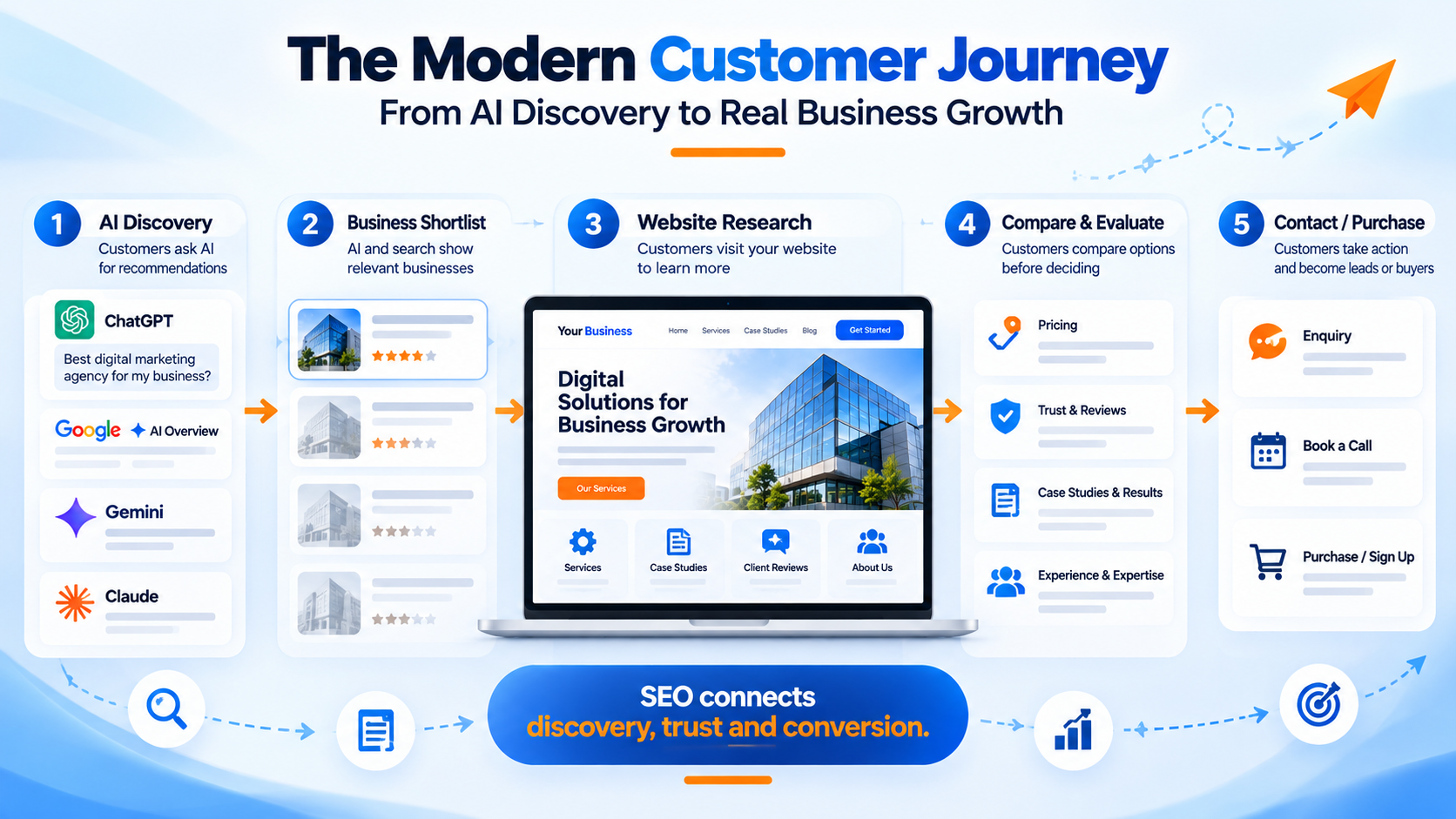
The path from a customer’s first question to a business decision is becoming less linear. Instead of searching, clicking the first relevant result, and then researching a company, customers can move between AI tools, search engines, review platforms, business websites, and other sources.
A typical journey may look like this:
| Stage |
What the Customer Is Doing |
Possible Role of AI |
Possible Role of the Website |
| Discovery |
Identifying possible solutions or businesses |
Surfaces options and provides an initial explanation |
Establishes the business as a source customers can explore |
| Exploration |
Understanding the available options |
Explains categories, alternatives, and common considerations |
Organizes the business’s specific offering |
| Evaluation |
Comparing shortlisted businesses |
Helps summarize differences and available information |
Provides company-specific details, evidence, and commercial information |
| Decision |
Choosing whether to move forward |
May answer remaining general questions |
Enables enquiries, purchases, bookings, demos, or consultations |
The stages do not always happen in this exact order. A customer might discover a company through Google, check its reviews, ask an AI assistant another question, return to the company’s website, and then contact the business.
What has changed is the number of places involved in the journey.
For businesses, this means the website should work as part of a wider discovery ecosystem rather than being treated as the only destination. Search engines and AI can help bring a business into consideration, while the website can support the later stages where the customer decides what to do next.
This also explains why website traffic alone does not tell the full story. A customer who visits after already narrowing down their options may be much closer to taking action than someone who arrives simply looking for a general definition.
The more useful question is therefore not just “How many people reached the website?” but “What role did the website play in helping those people move forward?”
Are All Website Visits Equally Important?
No.
A business should not necessarily judge its website only by how many visitors it receives. The value of a visit depends on what the visitor is trying to accomplish.
Consider two searches:
Search A:
“What is workers’ compensation insurance?”
A customer may get enough information from an AI response and never need to visit an insurer’s website.
Search B:
“Workers’ compensation insurance for a 25-person construction company in Texas.”
This customer may need considerably more information before making a decision. They may want to investigate providers, understand coverage options, request a quote, or speak with an insurance professional.
The second type of search has a stronger connection to a potential business action.
Why Do Customers Still Need to Verify a Business?
An AI recommendation can put a business on a customer’s shortlist, but being mentioned is not the same as being chosen. Before taking action, customers may want to confirm that the information they found actually applies to their situation.
This becomes particularly important when the decision involves money, contracts, personal information, or an ongoing relationship.
For example, a customer considering a local dental practice may want to confirm its current services, location, appointment options, accepted insurance, and treatment availability. A company evaluating a B2B software provider may need to check whether the platform supports its required integrations, security requirements, user capacity, and implementation process.
Verification can involve checking several details:
- Business identity: Is this the correct company and official website?
- Current offering: Does the business currently provide the product or service mentioned?
- Location: Does it serve the customer’s city, region, or market?
- Suitability: Does the offering match the customer’s specific requirements?
- Current details: Are important information such as pricing, availability, hours, or processes up to date?
- Next step: Is there a clear and legitimate way to contact, book, purchase, or request more information?
This does not mean customers will verify every detail every time. The level of checking usually depends on the importance and complexity of the decision.
A simple informational query may require little or no verification. A customer choosing a contractor, purchasing expensive equipment, selecting business software, or engaging a professional service may want considerably more confidence before proceeding.
This is one reason accuracy and consistency across a business’s online presence matter. If an AI answer, business profile, review site, and company website present conflicting information, the customer has more uncertainty to resolve.
The website therefore has another practical role in an AI-driven discovery journey: it can give customers a reliable place to confirm the details that matter before they take the next step.
Does AI Reduce Some Website Traffic?
It can, particularly for searches where the customer only needs a quick piece of information.
If someone searches for a simple definition, calculation, general explanation, or basic fact, an AI-generated answer may satisfy the query without requiring a website visit.
But commercial searches can involve a different type of intent.
| Query Type |
Example |
Likely Need |
| Informational |
“What is cloud accounting?” |
Basic explanation |
| Research |
“Cloud accounting vs traditional accounting” |
Comparison |
| Commercial |
“Best cloud accounting software for small businesses” |
Evaluate options |
| Transactional |
“Cloud accounting software pricing” |
Pricing or purchase information |
| Action-oriented |
“Book a cloud accounting demo” |
Direct business interaction |
The more a customer moves toward evaluation and action, the more useful business-specific information can become.
This is why a decline in some informational clicks does not automatically mean every type of website visit becomes less valuable.
What Makes a Website Worth Visiting?
A website is more useful when it provides something beyond a generic explanation that could be generated anywhere.
That could include:
- Detailed product specifications
- Service options
- Pricing information
- Customer stories
- Demonstrations
- Industry-specific solutions
- Original research
- Expert explanations
- Product documentation
- Case studies
- Booking or purchasing functionality
- Quote or consultation requests
- Account or customer support
For example, an AI can explain what a CRM platform does. But the company’s website can let a potential customer explore its actual features, view plans, watch a product demonstration, compare integrations, and start a trial.
That difference matters because the customer has moved from “Tell me about this” to “Help me decide whether this is right for me.”
What Should Business Owners Measure?
This changing search journey also means businesses may need to look beyond raw website traffic.
Useful questions include:
- Are visitors reaching important product or service pages?
- Are qualified visitors requesting quotes or demos?
- Are contact forms generating relevant leads?
- Are customers using booking or purchasing features?
- Which pages support conversions?
- Are branded searches increasing or changing?
- Which content helps customers move toward an action?
Traffic remains useful, but it is only one part of the picture.
A business could receive fewer visitors to a particular informational page while still generating valuable leads from product, service, pricing, comparison, or conversion-focused pages.
Practical Website Action Checklist
Business owners can use the following checklist to assess whether their website is ready for customers who may arrive after using AI or other discovery channels:
| Website Check |
What to Look For |
| Core service/product pages |
Can a potential customer understand exactly what you offer? |
| Customer-specific information |
Are important use cases, industries, or customer types clearly explained? |
| Decision-making details |
Are pricing, features, specifications, process, requirements, or other relevant details easy to find? |
| Proof of the offering |
Are there useful examples, case studies, demonstrations, or supporting details where appropriate? |
| FAQs |
Does the website address the questions customers commonly ask before contacting or buying? |
| Conversion paths |
Can visitors easily request a quote, book a call, make a purchase, start a trial, or contact the business? |
| Mobile experience |
Can customers access important information and take action easily on a phone? |
| Page clarity |
Can a visitor quickly understand what the page is about and what they should do next? |
| Content freshness |
Are important details such as products, services, pricing, locations, and processes still current? |
| Measurement |
Can the business identify which pages and actions contribute to leads, sales, or other meaningful outcomes? |
A useful test is to take the role of a potential customer who has just discovered the business through an AI answer.
Could that customer visit the website and find everything they need to decide what to do next without having to search somewhere else?
If the answer is no, that identifies a website improvement opportunity that has little to do with chasing rankings and much more to do with serving the customer.
What Happens If a Business Stops Maintaining Its Website and SEO?
SEO and website maintenance are not activities that a business completes once and then forgets about. Products change, services change, competitors publish new information, customer expectations evolve, and search systems continue to change how they present information.
If a business stops maintaining its website and search presence, the effects may not be immediately visible. A website can continue to rank, receive visitors, and generate leads for some time. The bigger issue is that its information and visibility can gradually become less useful or less competitive.
What Can Become Outdated?
A business website contains information that can change over time.
For example:
- Products may be discontinued.
- Services may change.
- Pricing information may become outdated.
- Business locations may change.
- Staff or contact details may change.
- Old offers may remain published.
- Industry regulations may change.
- Previously accurate advice may become incomplete.
- Competitors may introduce better or more useful resources.
Imagine a software company whose website still promotes features that were removed two years ago. Even if the company continues to appear in search results, the experience can create confusion when a potential customer discovers that the information no longer matches the current product.
Can Search Visibility Decline Over Time?
It can.
Search visibility is influenced by many factors, including relevance, competition, content quality, technical accessibility, and how well a page satisfies a searcher’s needs.
A page that performed well several years ago may face new competition from businesses publishing more useful or more current information.
For example, suppose a law firm created a detailed guide about a particular business regulation in 2023. Several competitors later publish updated guides reflecting changes through 2026.
The original page may still exist, but its information may no longer provide the same value.
This does not mean every old page automatically loses rankings. It means businesses should not assume that previous visibility will remain unchanged indefinitely.
What Happens When Competitors Keep Improving?
Stopping maintenance also creates an opportunity for competitors.
Consider two businesses in the same industry.
Business A continues updating its important service pages, answering new customer questions, improving its website experience, and publishing relevant expertise.
Business B leaves its website largely unchanged for several years.
Even if both businesses once had similar online visibility, their websites may gradually provide very different experiences for customers.
The difference is not necessarily about publishing more content. Business A may simply have more current, useful, and relevant information.
Can Outdated Information Affect Customer Trust?
Yes, particularly when customers notice obvious inconsistencies.
Examples include:
- A website lists an old address.
- A service page describes something the company no longer offers.
- Contact information no longer works.
- A homepage promotes an expired offer.
- Business hours are incorrect.
- Product specifications are outdated.
- Old team members are still presented as current staff.
These problems can affect the customer’s experience regardless of whether the visitor arrived through Google, an AI system, a social platform, or a direct referral.
The issue is not simply SEO. It is that the business is presenting information that no longer reflects the business itself.
What Happens to Older Content?
Not every old article needs to be deleted.
A useful review can place existing content into four categories:
| Content Status |
Possible Action |
| Still accurate and useful |
Keep and maintain |
| Useful but outdated |
Update with current information |
| Overlapping or repetitive |
Consolidate where appropriate |
| No longer relevant |
Remove, redirect, or replace where appropriate |
For example, a 2024 guide about a software product may still attract relevant visitors, but if the product has changed significantly, updating the guide can provide a better experience than leaving the old version untouched.
What Is the Business Impact of Letting SEO and the Website Go Stale?
For a business owner, the most important issue is not the SEO metric itself. It is what changes in the business when potential customers can no longer find, understand, or act on current information as easily.
The impact can appear in several areas:
| Business Area |
Possible Impact of Poor Maintenance |
| Lead generation |
Fewer qualified prospects may reach important service or product pages |
| Conversions |
Outdated or unclear information can create friction before a customer takes action |
| Sales opportunities |
Potential buyers may move to competitors when they cannot quickly find relevant information |
| Customer experience |
Incorrect details can create confusion, additional questions, or frustration |
| Brand perception |
An outdated website may make the business appear less current than it actually is |
| Marketing efficiency |
Existing content and organic visibility may become less productive over time |
| Competitive position |
Competitors that continually improve their online presence can capture more attention |
| Business changes |
New products, locations, services, or markets may not be properly represented online |
These effects will not occur at the same rate for every business. A local service company, an e-commerce brand, and a B2B software provider have different customer journeys and different levels of dependence on organic discovery.
But the underlying business risk is similar: an outdated online presence can create a gap between what the company actually offers and what potential customers see when they research it.
What Should Businesses Maintain Regularly?
A business does not need to make major changes every week. A practical maintenance process can focus on the pages and information that matter most.
Monthly or Regular Checks
- Important contact forms and conversion paths
- Key product and service pages
- Business hours and contact details
- Major technical issues
- Important website analytics
- New customer questions
Quarterly or Periodic Reviews
- Top-performing pages
- Declining pages
- Outdated content
- Competitor changes
- Search queries bringing qualified visitors
- Conversion performance
- Business profiles and third-party listings
When the Business Changes
Immediate website updates may be appropriate when the company:
- Launches a new product
- Removes a service
- Changes pricing
- Expands into a new location
- Changes its target market
- Rebrands
- Introduces a new process
- Changes contact information
This approach makes maintenance a normal part of operating the business rather than a separate SEO project that only happens when rankings fall.
A Simple Website Maintenance Test
Business owners can periodically ask five questions:
- Does the website accurately describe what we offer today?
- Can customers still find the information they need to make a decision?
- Are our most important pages current and useful?
- Are there technical or conversion problems preventing customers from taking action?
- Are we adapting when our market, customers, or competitors change?
If the answer to several of these questions is no, the issue may be bigger than declining search traffic. The company’s website may simply no longer be keeping pace with the business.
The Real Risk Is Falling Out of Sync
The biggest concern with abandoning SEO and website maintenance is not that a website suddenly becomes invisible.
It is that the business, its website, and the way customers search for information gradually move in different directions.
The business may change while the website stays the same. Customers may ask new questions while the content answers old ones. Competitors may provide better information while the company’s pages remain unchanged.
Maintaining the website and search presence helps reduce that gap.
And this brings us to the central question of the article: if SEO has changed rather than disappeared, what does SEO actually mean for a business owner in 2026?
Is SEO Dead, or Has the Role of SEO Changed?
The short answer is that SEO has changed, but its role has not disappeared.
For business owners, the bigger change is how people discover, research, and evaluate businesses online. Search is no longer limited to typing keywords into Google and choosing one of several blue links. Customers can now use AI-powered search experiences, traditional search results, reviews, business profiles, industry websites, social platforms, and other sources during the same decision-making process.
That means SEO should no longer be viewed only as a method for getting pages to rank.
It is better understood as part of a broader effort to make a business discoverable, understandable, useful, and actionable online.
What Has Actually Changed?
Traditional SEO often focused on improving a website’s visibility for specific searches.
That still matters, but the environment around search has become more complex.
A customer may now:
- Ask an AI system a question.
- Receive a summary or several possible businesses.
- Search for a specific company.
- Read reviews or third-party information.
- Visit the company’s website.
- Compare products or services.
- Request a quote, book an appointment, make a purchase, or contact the business.
The business does not necessarily control which step happens first.
What it can control is how well its online presence supports the customer throughout that journey.
What Does SEO Mean for a Business Owner in 2026?
For a business owner, SEO can be thought of in several connected layers:
| SEO Role |
Business Purpose |
| Discoverability |
Help potential customers find relevant business information |
| Relevance |
Connect the business with searches related to its products or services |
| Clarity |
Make it easy to understand what the business offers and who it serves |
| Content |
Provide useful information for customers researching a problem or purchase |
| Credibility |
Support business claims with relevant evidence and external references |
| Experience |
Help visitors find information and complete important actions |
| Adaptation |
Keep the online presence aligned with changes in the business and market |
These areas work together.
A business can have strong content but poor conversion paths. It can have a technically sound website but unclear service information. It can rank for informational searches but provide little information for customers who are ready to buy.
SEO therefore becomes less about one isolated ranking metric and more about how effectively the business is represented across the online discovery process.
Does AI Make SEO Unnecessary?
AI changes how information is presented, but it does not remove the need for businesses to have useful information available online.
AI systems and search engines still need information from somewhere to understand businesses, products, services, topics, and customer questions.
More importantly, customers still need detailed information when they move beyond basic discovery.
An AI response may tell someone what a company does. The company’s website can help that person understand its services, compare options, review examples, learn about the process, and take the next step.
So the practical question for a business owner is not:
“How do I compete with AI?”
It is:
“How do I make sure my business provides useful, accurate, and accessible information wherever customers are looking?”
What Should Business Owners Focus On?
Businesses do not necessarily need to react to every new AI feature or search-industry development.
Instead, they can focus on fundamentals that remain useful across different discovery channels.
- Keep the website useful
Make important products, services, processes, and customer information easy to understand.
- Keep important information current
Update pages when the business changes rather than allowing outdated information to remain online.
- Create content for real customer questions
Focus on information that helps customers understand problems, evaluate solutions, and make decisions.
- Build genuine business credibility
Use real customer experiences, relevant industry participation, original expertise, and other legitimate evidence where appropriate.
- Make conversion easy
A customer who decides to take action should be able to request a quote, book, purchase, contact the company, or complete the relevant next step without unnecessary friction.
- Measure business outcomes
Look beyond rankings and traffic alone. Leads, sales, bookings, inquiries, and other meaningful actions show whether online visibility is contributing to the business.
What Should Businesses Not Do?
The shift toward AI also creates some opportunities for businesses to overreact.
There is no need to assume that every website needs hundreds of AI-generated articles, constant content publishing, or a completely new SEO strategy every time a search platform introduces a new feature.
Businesses should be cautious about:
- Publishing large amounts of repetitive content
- Creating pages without a clear customer purpose
- Chasing every new SEO trend
- Measuring success only through keyword rankings
- Ignoring existing website and conversion problems
- Allowing outdated business information to remain online
- Treating AI-generated content as a substitute for genuine business expertise
The better approach is to understand what customers need and then make that information available in a clear, useful, and sustainable way.
So, Is SEO Still Important for a Business Website?
Yes, but its importance should be understood in the context of the entire customer journey.
SEO can help a business become discoverable. Its website can provide deeper information. Third-party sources can provide additional context. Content can help customers evaluate their options. And a strong conversion experience can turn that interest into a business action.
The pieces are connected.
The goal is not simply to get a customer to click a search result.
The goal is to make sure that when a potential customer is looking for a solution your business provides, they can discover the business, understand its relevance, find the information they need, and take the next step.
The Bottom Line for Business Owners
SEO is not best understood as a tactic that belongs only to the Google era.
It is part of how a business makes itself findable and understandable in an increasingly complex digital environment.
AI may change where customers ask questions, how answers are presented, and how often they click traditional search results. But businesses still need accurate information, useful content, credible signals, functional websites, and clear paths to conversion.
So the question for 2026 is not simply:
“Is SEO dead?”
A more useful business question is:
“Is our online presence helping the right customers discover us, understand us, trust the information they find, and take action?”
That is the role SEO increasingly plays in the AI era.