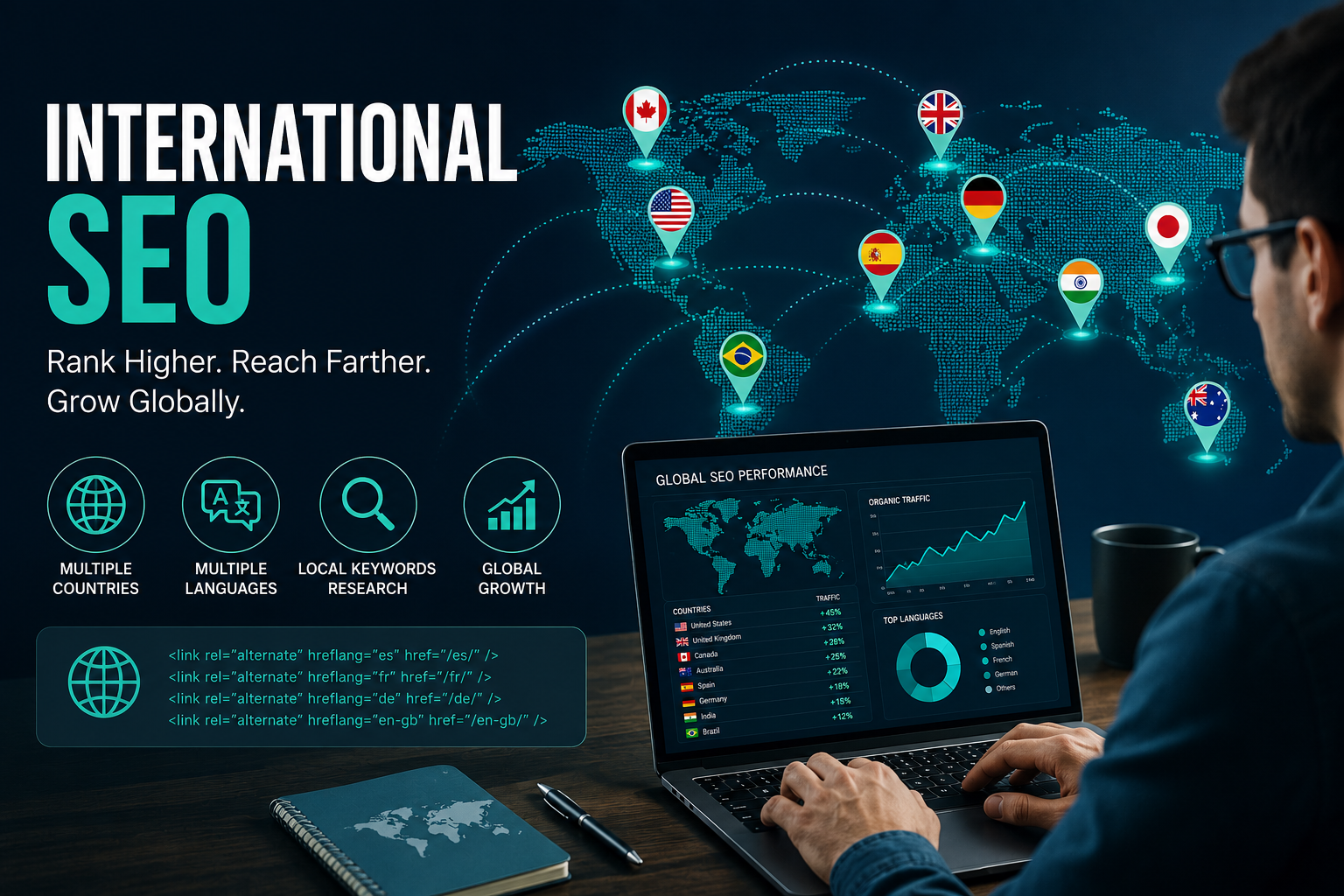
The internet has eliminated geographical barriers, making it easier than ever for businesses to reach customers around the world. Whether you’re an eCommerce brand selling internationally, a SaaS company acquiring users across continents, or a service-based business targeting multiple regions, expanding into global markets has become a major growth opportunity. However, reaching international audiences isn’t as simple as launching a multilingual website, it requires a well-planned international SEO strategy.
The way people search has also changed dramatically. Today, users don’t rely solely on traditional Google search results. They increasingly discover brands through Google AI Overviews, AI-powered search experiences, and conversational AI platforms like ChatGPT, Gemini, Claude, and Perplexity. These AI systems generate answers by analyzing trustworthy, well-structured, and locally relevant content. If your website isn’t optimized for different countries, languages, and regions, you’re not only limiting your visibility in search engines, you as a digital marketing agency may also miss opportunities to appear in AI-generated responses.
Many businesses assume that translating their website into another language is enough to rank internationally. Unfortunately, that’s one of the biggest misconceptions about international SEO. Search engines and AI search assistants don’t simply evaluate language, they assess regional relevance, localized keywords, search intent, website structure, technical implementation, and user experience before deciding which pages deserve visibility.
For example, an online retailer expanding from the United States into Spain can’t simply translate product pages from English to Spanish. Spanish users search with different keywords, expect prices in euros, follow unique shopping habits, and respond to localized messaging. Likewise, English-speaking users in the United States, the United Kingdom, Australia, and Canada use different spellings, terminology, and search behavior. A successful global SEO strategy adapts content to each market instead of treating every audience the same.
International expansion also introduces technical challenges. Should you use country-code top-level domains (ccTLDs), subdomains, or subdirectories? How do you conduct international SEO keyword research to uncover the search terms people actually use in different countries? When should you implement hreflang tags? How do you prevent duplicate content issues while ensuring search engines and AI platforms show the correct version of your pages to the right audience?
The good news is that with the right international SEO services or a well-executed strategy, your website can rank across multiple countries, increase qualified organic traffic, strengthen brand visibility, and improve your chances of being cited in AI-powered search experiences. As search continues to evolve, SEO for international markets is no longer just about ranking on Google, it’s about building globally relevant content that both search engines and AI assistants trust enough to recommend.
In this complete guide, you’ll learn:
- What international SEO is and why it matters in the age of AI-powered search.
- How to build an effective international SEO strategy for multiple countries and languages.
- How to choose the right country and language targeting approach.
- How to perform international SEO keyword research for global audiences.
- The best website structures for SEO for multiple countries.
- How to implement hreflang tags correctly.
- Technical SEO best practices for international websites.
- How to localize content instead of simply translating it.
- The most common international SEO mistakes to avoid.
- A practical international SEO checklist to help digital marketing agency launch and optimize your global website successfully.
By the end of this guide, you’ll have a clear roadmap for implementing international search engine optimization that helps your website rank in multiple countries, reach international customers, and stay visible in both traditional search results and the rapidly growing world of AI-powered search experiences.
What Is International SEO?
International SEO is the process of optimising a website so that search engines can identify the countries and languages a business wants to target. It helps search engines deliver the most relevant version of a webpage to users based on their geographic location and language preferences. Unlike traditional SEO, which focuses on improving rankings in a single market, international SEO ensures that websites perform well across multiple countries and regions.
Several factors contribute to successful international SEO. These include using hreflang tags to indicate language and regional targeting, creating country-specific or language-specific URLs, conducting local keyword research, producing culturally relevant content, selecting appropriate domain structures (such as ccTLDs, subdomains, or subdirectories), optimising website loading speed in different regions, and earning backlinks from local websites. Maintaining consistent technical SEO and providing a positive user experience are also essential.
International SEO is important because it enables businesses to reach global audiences, increase organic traffic from international markets, and improve visibility in country-specific search results. It also enhances user experience by presenting content in the user’s preferred language, leading to higher engagement, greater trust, and improved conversion rates. For organisations expanding internationally, international SEO provides a scalable strategy for building brand awareness and driving sustainable global growth.
International SEO vs. Local and National SEO
Although all three improve search visibility, they serve different purposes.
| SEO Type |
Target Audience |
Primary Focus |
| Local SEO |
One city or region |
Location-based searches like “coffee shop near me.” |
| National SEO |
One country |
“best life insurance in the UK” or “buy laptops online UK” |
| International SEO |
Multiple countries and languages |
“buy running shoes in Germany” (German version), “acheter des chaussures de course en France” (French version), or “international shipping to Australia” |
A business serving customers worldwide needs a global SEO strategy rather than a local or national approach. This is especially important for companies managing SEO for multiple countries or multilingual websites.
How Google Determines Country Relevance
Google uses several signals to understand which country or language your content targets, including:

- Hreflang tags
- Country-specific domains, subdomains, or subdirectories
- Localized content instead of direct translations
- International keyword research based on regional search behavior
- Local backlinks and user experience signals
When these elements work together, Google can deliver the most relevant version of your website to users in different countries.
Examples of International Websites
Many global brands successfully implement global SEO by creating localized experiences for different regions.

Examples include:
- Amazon
- Apple
- Airbnb
- Netflix
Each provides country-specific content, languages, currencies, and localized user experiences instead of serving the same website to every visitor.
Why International SEO Matters
Whether you’re targeting one additional country or expanding globally, international SEO helps search engines understand your target audience and improves your visibility in international search results. A well-planned international SEO strategy can increase qualified organic traffic, improve user experience, and help your business compete effectively in global markets.
How Search Engines Understand International Websites
Simply translating your website isn’t enough for search engines to understand which audience you’re targeting. To succeed with international SEO, as a digital marketing agency you need to provide clear signals that help search engines identify the right language and country for each page. This is a fundamental part of any successful international SEO strategy and one of the most important international SEO best practices.
Search engines like Google analyze multiple factors before deciding which version of your website should appear in a particular country. When these signals work together, your pages have a better chance of ranking in the right international market.
1. Language
Language is the first signal search engines use to understand your content. Creating pages in your audience’s native language helps Google match users with the most relevant results.
However, language alone isn’t enough. For example, English content may target users in the United States, the United Kingdom, Australia, or Canada. That’s why SEO for international websites requires additional targeting signals.
2. Country Targeting
Google also determines which country your content is intended for. Businesses targeting multiple regions should optimize content specifically for each market instead of using one generic version for everyone.
A well-planned global SEO strategy considers local search behavior, currencies, measurements, and cultural preferences, making it easier to rank in different countries.
3. IP Address and Server Location
Although server location is no longer a primary ranking factor due to the widespread use of Content Delivery Networks (CDNs), server performance remains an important aspect of International SEO. A fast, reliable server ensures that users in different countries can access your website quickly, reducing page load times and improving the overall browsing experience. Search engines prioritise websites that provide a positive user experience, making site speed an indirect but valuable ranking signal. By hosting content efficiently and using CDNs to deliver pages from servers closer to international users, businesses can improve website performance, reduce bounce rates, and support stronger search visibility across global markets.
4. Country-Code Top-Level Domains (ccTLDs)
Using country-specific domains such as:
- example.co.uk (United Kingdom)
- example.de (Germany)
- example.fr (France)
gives Google a strong indication that your website targets users in a specific country. Although ccTLDs aren’t required, they remain an effective option for businesses focusing on individual markets as part of their international SEO strategy.
5. Hreflang Tags
Hreflang tags tell Google which language and regional version of a page should be shown to different users.

For example:
- English (US)
- English (UK)
- Spanish (Spain)
Correct hreflang implementation is one of the most important international SEO best practices because it helps prevent duplicate content issues and ensures users land on the most relevant page.
6. Canonical Tags
Canonical tags help search engines identify the preferred version of similar pages. When managing multilingual or multi-regional websites, using canonical tags correctly prevents indexing issues while working alongside hreflang tags.
This is an essential part of SEO for multiple countries where similar content exists across different regional websites.
7. User Signals
Search engines also evaluate how users interact with your website. Positive engagement signals indicate that your content satisfies search intent.
Some important user signals include:
- Click-through rate (CTR)
- Time on page
- Bounce rate
- User engagement
- Page experience
Localized content often performs better because it matches the expectations of users in each market, strengthening your international SEO marketing efforts.
How Google Understands an International Website
Googlebot
Detects Language
Identifies Country Signals
(Hreflang • ccTLD • Content • Canonical)
Evaluates User Signals
Ranks the Most Relevant Page
Search engines don’t rely on a single ranking factor. Instead, they combine language, country targeting, technical SEO, and user behavior to determine which page should appear for each audience. That’s why successful international SEO requires both technical implementation and localized content to improve visibility across global search results.
International Website Structures: Which One Is Best for SEO?
Choosing the right website structure is one of the most important decisions you’ll make when building an international SEO strategy. Your URL structure helps search engines understand which countries and languages your website targets, making it easier to rank in multiple regions.
There isn’t a one-size-fits-all solution. The best structure depends on your business goals, budget, technical resources, and the number of countries you’re targeting. Below are the three most common options used in international search engine optimization.
Option 1: Country Code Top-Level Domains (ccTLDs)
A Country Code Top-Level Domain (ccTLD) uses a unique domain extension for each country.
Example:
- example.co.uk (United Kingdom)
- example.de (Germany)
- example.fr (France)
Pros
- Strong country-targeting signal for Google.
- Builds trust with local users.
- Ideal for businesses operating independently in different countries.
- Often performs well in SEO for international markets.
Cons
- Higher registration and maintenance costs.
- Requires separate SEO efforts for each domain.
- Building domain authority takes longer since backlinks are spread across multiple domains.
Best for:
Businesses with dedicated teams, large budgets, and separate operations in each country.
Option 2: Subdomains
Subdomains create separate sections for each country under the main domain.
Example:
- uk.example.com
- de.example.com
- fr.example.com
Pros
- Easier to manage than multiple domains.
- Allows different hosting environments if needed.
- Flexible for large international websites.
Cons
- Google may treat subdomains as separate websites.
- Authority isn’t shared as effectively as with subdirectories.
- Requires additional SEO management.
Best for:
Large businesses that need technical flexibility across different markets.
Option 3: Subdirectories
Subdirectories place country-specific content within folders on the main domain.
Example:
- example.com/uk/
- example.com/de/
- example.com/fr/
Pros
- Shares domain authority across all country pages.
- Easier to manage and maintain.
- Lower development and hosting costs.
- Simplifies analytics and tracking.
- Recommended for most international SEO projects.
Cons
- Slightly weaker country signal than ccTLDs.
- Requires proper hreflang implementation and localized content.
Best for:
Most businesses expanding internationally, especially those targeting multiple countries while maintaining a single website.
Website Structure Comparison
Compare the three most common international website structures to understand their SEO impact, maintenance requirements, costs, and ideal use cases, helping you as a digital marketing agency choose the best option for your global expansion strategy.

| Structure |
SEO Strength |
Maintenance |
Cost |
Best For |
| ccTLDs (example.co.uk) |
Strong country targeting |
High |
High |
Large international businesses |
| Subdomains (uk.example.com) |
Good |
Medium |
Medium |
Businesses needing technical flexibility |
| Subdirectories (example.com/uk/) |
Excellent for global SEO |
Low |
Low |
Most businesses targeting multiple countries |
Which Website Structure Should You Choose?
For most businesses, subdirectories offer the best balance of SEO performance, cost, and ease of management. They allow digital marketing agency to build authority under a single domain while supporting an effective international SEO strategy.
However, if your business operates independently in multiple countries with separate branding, legal requirements, or teams, ccTLDs may be the better choice despite the higher maintenance costs. Subdomains can also be a practical option when different regions require separate technical infrastructure.
Ultimately, the right structure should align with your business goals, scalability, and long-term global SEO strategy. Regardless of the option you choose, combine it with proper hreflang implementation, localized content, and international SEO best practices to improve visibility across international markets.
International SEO Strategy: Step-by-Step Guide
A successful international SEO strategy is more than translating your website into multiple languages. It requires understanding your target markets, researching local search behavior, creating region-specific content, and implementing technical SEO correctly. Whether you’re targeting two countries or twenty, following a structured process will help digital marketing agencies improve visibility and avoid costly mistakes.
Below is a proven framework used in successful international SEO strategies.
Step 1: Conduct Market Research
Before expanding globally, identify which international markets offer the best opportunities. Targeting every country isn’t always the smartest approach. Instead, focus on markets with strong demand for your products or services.
When evaluating new markets, consider:
- Search demand for your products or services.
- Competition and how difficult it is to rank.
- GDP and purchasing power to estimate market potential.
- Buying behavior and customer preferences.
- Language and cultural differences.
- Local search engines (Google, Bing, Baidu, Naver, etc., where applicable).
Prioritizing the right countries helps digital marketing agency invest your SEO efforts where they’ll deliver the highest return.
Step 2: Perform International Keyword Research
One of the biggest mistakes businesses make is using the same keywords across every country. Even when two countries speak the same language, people often search differently. That’s why international SEO keyword research is an essential part of every international SEO strategy.
What to Research
- Country-specific search volume.
- Regional spelling variations.
- Local terminology.
- User search intent.
- Long-tail keywords used in each market.
For example:
| United States |
United Kingdom |
| Color |
Colour |
| Apartment |
Flat |
| Vacation |
Holiday |
| Truck |
Lorry |
These differences affect rankings because users search using familiar local terms. Effective international keyword research ensures you’re optimizing for what your audience actually searches, not simply translating keywords.
Best Tools for International Keyword Research
Several SEO tools make international SEO keyword research easier:
- Google Keyword Planner – Country-specific keyword data.
- Ahrefs – International keyword opportunities and competitor analysis.
- SEMrush – Regional keyword tracking and search trends.
- Google Search Console – Discover countries already driving traffic.
- Google Trends – Compare keyword popularity across different regions.
Using these tools helps digital marketing agency identify valuable opportunities and build content that matches local search behavior.
Step 3: Localize Your Content (Not Just Translate It)
Translation converts words from one language to another. Localization adapts your content to match the language, culture, and expectations of a specific audience.
For SEO for international websites, localization almost always delivers better results than direct translation.
Translation vs. Localization
| Translation |
Localization |
| Converts text into another language. |
Adapts content for local users. |
| Same message. |
Region-specific messaging and examples. |
| Literal wording. |
Natural language and cultural relevance. |
Examples of Localization
| United States |
United Kingdom |
| Color |
Colour |
| Apartment |
Flat |
| Vacation |
Holiday |
| Zip Code |
Postcode |
Localization should also include:
- Local currencies (USD, GBP, EUR)
- Date formats (MM/DD/YYYY vs DD/MM/YYYY)
- Measurement units (Miles vs Kilometers)
- Time formats
- Calls-to-action (CTAs)
- Images and cultural references
Localized content improves user experience and supports both international SEO marketing and better search rankings.
Step 4: Choose the Right URL Structure
Your website structure tells search engines how your international content is organized.
Common options include:
Country folders
- example.com/us/
- example.com/uk/
- example.com/de/
Language folders
- example.com/en/
- example.com/fr/
- example.com/es/
Whichever structure digital marketing agency choose, keep it consistent across your website.
Avoid creating duplicate pages that target the same audience with nearly identical content. Every country or language version should provide unique value for its users. This is one of the most important international SEO best practices for managing SEO for multiple countries.
Step 5: Implement Hreflang Tags Correctly
One of the most critical technical elements of international search engine optimization is hreflang implementation.
If you’re wondering how to use hreflang tags for international SEO, the goal is simple:
Hreflang tells search engines which language and regional version of a page should be shown to different users.
Basic Hreflang Syntax
<link rel=”alternate” hreflang=”en-us” href=”https://example.com/us/” />
<link rel=”alternate” hreflang=”en-gb” href=”https://example.com/uk/” />
<link rel=”alternate” hreflang=”fr-fr” href=”https://example.com/fr/” />
In this example:
- en-us targets English speakers in the United States.
- en-gb targets users in the United Kingdom.
- fr-fr targets French users in France.
Google uses these tags to serve the correct page to the correct audience.
Self-Referencing Hreflang
Every page should reference itself as well as its alternate versions.
Example:
US page references:
- US version
- UK version
- French version
This helps Google understand the relationship between pages.
Using x-default
The x-default attribute tells Google which page should appear when no language or regional match exists.
Example:
<link rel=”alternate” hreflang=”x-default” href=”https://example.com/” />
This is commonly used for global homepages or language-selection pages.
Common Hreflang Mistakes
Avoid these common implementation errors:
- Missing return (reciprocal) tags.
- Incorrect language or country codes.
- Using hreflang without localized content.
- Forgetting self-referencing tags.
- Pointing hreflang to redirected or broken URLs.
- Using canonical tags that conflict with hreflang.
These mistakes can prevent Google from showing the correct version of your pages.
Validate Your Hreflang Implementation
After implementation, test your hreflang setup using trusted SEO tools such as:
- Google Search Console
- Ahrefs Site Audit
- SEMrush Site Audit
- Screaming Frog SEO Spider
- TechnicalSEO.com’s Hreflang Testing Tool
Regular validation helps identify errors before they affect your international rankings.
Key Takeaway
A successful international SEO strategy combines market research, international SEO keyword research, localized content, a scalable URL structure, and accurate hreflang implementation. When these elements work together, search engines can better understand your website, helping digital marketing agency rank in the right countries and deliver the best experience to international users.
Common International SEO Mistakes to Avoid
Even the best international SEO strategy can fail if common mistakes are overlooked. From poor localization to technical implementation errors, these issues can prevent your website from ranking in the right countries and languages. Following international SEO best practices helps ensure search engines understand your website and deliver the correct pages to international users.
Here are some of the most common mistakes businesses make when expanding globally.
1. Machine-Translating Pages
Using automated translation tools without human review often results in unnatural content that doesn’t match local language or culture.
Instead of simply translating content, focus on localization by adapting your messaging, examples, currencies, and calls-to-action for each target market. This improves both user experience and SEO for international websites.
2. Incorrect Hreflang Implementation
Hreflang errors are one of the most common technical issues in international search engine optimization.
Common mistakes include:
- Using incorrect language or country codes.
- Missing return (reciprocal) tags.
- Forgetting self-referencing hreflang tags.
- Incorrect use of the x-default attribute.
Always validate your hreflang implementation to ensure users are directed to the correct regional page.
3. Duplicate Content Across Countries
Publishing identical content for multiple countries can confuse search engines, especially when pages only differ by currency or a few words.
Instead, create localized content and use canonical and hreflang tags correctly to help Google understand which version of a page should be indexed.
4. Relying on a VPN Instead of Localization
Some businesses believe showing the same content through different IP addresses or using VPN-based redirects is enough for international targeting.
It isn’t. International SEO requires localized content, proper URL structures, hreflang tags, and country-specific optimization, not just location-based redirects.
5. Ignoring Local Search Intent
People in different countries don’t always search the same way.
For example:
- Vacation vs. Holiday
- Apartment vs. Flat
- Sneakers vs. Trainers
Conducting international SEO keyword research helps digital marketing agency understand regional search behavior and optimize content for the keywords your audience actually uses.
6. Poor Internal Linking
Many international websites fail to connect related country or language pages effectively. A strong internal linking strategy helps search engines discover your content, distributes authority across regional pages, and improves navigation for users.
7. Choosing the Wrong URL Structure
Selecting an unsuitable website structure can create maintenance challenges and weaken your global SEO strategy. Whether you use ccTLDs, subdomains, or subdirectories, keep the structure consistent and align it with your long-term business goals.
8. Ignoring Local Backlinks
Backlinks from websites in your target country send strong relevance signals to search engines. Instead of relying only on links from your home country, earn backlinks from local publications, industry websites, directories, and regional partners to strengthen your SEO for international markets.
9. Missing Country-Specific Schema
Structured data should also reflect your international presence. Depending on your business, consider implementing:
- Organization Schema
- Local Business Schema
- Product Schema
- Breadcrumb Schema
- FAQ Schema
Adding relevant schema markup helps search engines better understand your content and supports your overall international SEO strategy.
International SEO Checklist
Before launching your website in new markets, use this international SEO checklist to ensure every essential element is in place. From planning and technical SEO to localization and analytics, this checklist will help digital marketing agency build a strong international SEO strategy and improve your chances of ranking in multiple countries.
Planning
Start with a clear plan before creating international versions of your website.
- □ Select your target countries and languages.
- □ Conduct competitor analysis for each market.
- □ Perform international SEO keyword research using country-specific data.
- □ Understand local search intent and customer behavior.
- □ Choose the right website structure (ccTLD, subdomain, or subdirectory).
Technical SEO
A strong technical foundation is essential for international search engine optimization.
- □ Implement hreflang tags correctly.
- □ Configure canonical tags to prevent duplicate content.
- □ Create and submit XML sitemaps.
- □ Ensure your website is mobile-friendly.
- □ Improve Core Web Vitals and page speed.
- □ Secure every page with HTTPS.
- □ Verify country and language targeting.
Content & Localization
Successful SEO for international websites goes beyond translation.
- □ Create localized content for each target audience.
- □ Use local currencies (USD, GBP, EUR, etc.).
- □ Display region-specific measurement units.
- □ Adapt dates, time formats, and contact information.
- □ Localize calls-to-action (CTAs).
- □ Optimize metadata with localized keywords.
- □ Avoid duplicate or machine-translated content.
Authority Building
Building trust in each market strengthens your global SEO strategy.
- □ Earn backlinks from local websites.
- □ Build local citations where relevant.
- □ Encourage customer reviews from each target country.
- □ Partner with regional publications and industry websites.
- □ Maintain consistent brand information across local directories.
Analytics & Monitoring
Track your international SEO performance to measure growth and identify opportunities.
- □ Set up country-specific traffic reports in Google Analytics.
- □ Track conversions for each country or language.
- □ Monitor rankings for localized keywords.
- □ Verify international pages in Google Search Console.
- □ Check indexing, crawl errors, and hreflang reports regularly.
- □ Perform a regular international SEO audit to identify technical and content issues.
Conclusion
Expanding your business into international markets is no longer just an opportunity, it’s a necessity for brands that want to reach a global audience. However, succeeding across multiple countries requires more than translating your website. A successful international SEO strategy combines technical optimization, localized content, international SEO keyword research, hreflang implementation, and continuous performance monitoring to help search engines understand your target audience.
As search continues to evolve with Google AI Overviews, ChatGPT, Gemini, Perplexity, and other AI-powered search experiences, businesses need to create content that is not only optimized for traditional search engines but also trustworthy, relevant, and localized for users worldwide. Investing in international search engine optimization today will help your business stay competitive in both conventional search results and the future of AI-driven discovery. Whether you’re targeting one new country or managing websites across multiple regions, following the international SEO best practices covered in this guide will help digital marketing agency improve visibility, attract qualified international traffic, and deliver a better user experience for every market digital marketing agency serves.
If you’re ready to grow your business globally but need expert guidance, partnering with an experienced provider of international SEO services can simplify the process. From technical implementation and localization to country-specific SEO strategies, the right team can help digital marketing agency build a scalable international presence and achieve long-term success in global search. The sooner you optimize your website for international audiences, the sooner you’ll start reaching customers wherever they search.